Hybrid Intelligence for Healthcare
The workshop will be held on July 7th, in room I.1.03 (see the HHAI2026 website for more information).
Schedule
| Time | Activity |
|---|---|
| 9:00-9:15 | Introduction |
| 9:15-10:30 | Keynote by Judith Masthoff: Adapting AI to People in Context: Human-Centred Hybrid Intelligence for Healthcare |
| 10:30-11:00 | Break |
| 11:00-12:00 | Lightning Talks by accepted papers: |
| 11:00 - 11:15 | Christian Fleiner and Robbe Claeys. The Ishikawa Diagram as an Enabler for Hybrid Intelligence in Healthcare |
| 11:15 - 11:30 | Abdallah Al-Janabi and Michel Klein. Hybrid Causal Discovery Using Human- and LLM-Based Domain Expertise |
| 11:30 - 11:45 | Floris den Hengst, Shihan Wang, Piek Vossen, Quirine Smit, Maaike H. T. de Boer, Bram Willemsen and Ilke Asal. Towards a Hybrid Diabetes Lifestyle Support Agent with a Long-Term Memory |
| 11:45 - 12:00 | Tommaso Zendron, Josephine Mélot Chesnel, Berke Yazan and Emma M. van Zoelen. AI as a Mediator of Information: a Consent-Aware Team Design Pattern for Appropriate Trust in Healthcare |
| 12:00-12:15 | Introduction of Design Patterns |
| 12:15-13:00 | Creation of Design Patterns Part 1 (in groups) |
| 13:00-14:00 | Lunch |
| 14:00-16:00 | Creation of Design Patterns Part 2 (in groups) |
| 16:00-16:30 | Break |
| 16:30-17:00 | Plenary session to show the design patterns and discuss common patterns |
| 17:00-17:30 | Closure and Next Steps |
This full-day workshop is an initiative of the HI-TNO collaboration and aims to build an interdisciplinary research community for people who are interested in developing hybrid intelligence (HI) systems for health care and well-being. The workshop will contain a combination of a keynote, lightning talks and an interactive session to work out common building blocks for various health care applications, using a design pattern approach. During the workshop, we will work on different design patterns that we may encounter when working on HI systems in healthcare settings. We aim to provide a space for sufficient communication and discussion, to build further on an interdisciplinary community for HI for health care and define commonly used design patterns that can be used in future research. Additionally, we have as goal to jointly write a paper after the workshop with the participants.
The workshop setup will be based on two different prior workshops, namely Hybrid Intelligence for healthcare (HHAI 2024, workshop website) and Human-Centered Design of Symbiotic Hybrid Intelligence (HHAI 2022, workshop website).
See also the output from those workshops:
[1] Dudzik, B. J., van der Waa, J. S., Chen, P. Y., Dobbe, R., de Troya, Í. M., Bakker, R. M., ... & Kamphorst, B. A. (2024). Hybrid intelligence supports application development for diabetes lifestyle management. Journal of Artificial Intelligence Research, 80, 919-929.
[2] Van Zoelen, E., Mioch, T., Tajaddini, M., Fleiner, C., Tsaneva, S., Camin, P., ... & Neerincx, M. A. (2023). Developing team design patterns for hybrid intelligence systems. In HHAI 2023: Augmenting Human Intellect (pp. 3-16). IOS Press.
Background
As technology, particularly intelligent systems, becomes more integrated into people’s daily life, AI-based systems designed to facilitate lifestyle change or behavior change for health and well-being become more common as well. However, there is still a long process going from research that develops such support systems to deploying such systems in people’s everyday life.
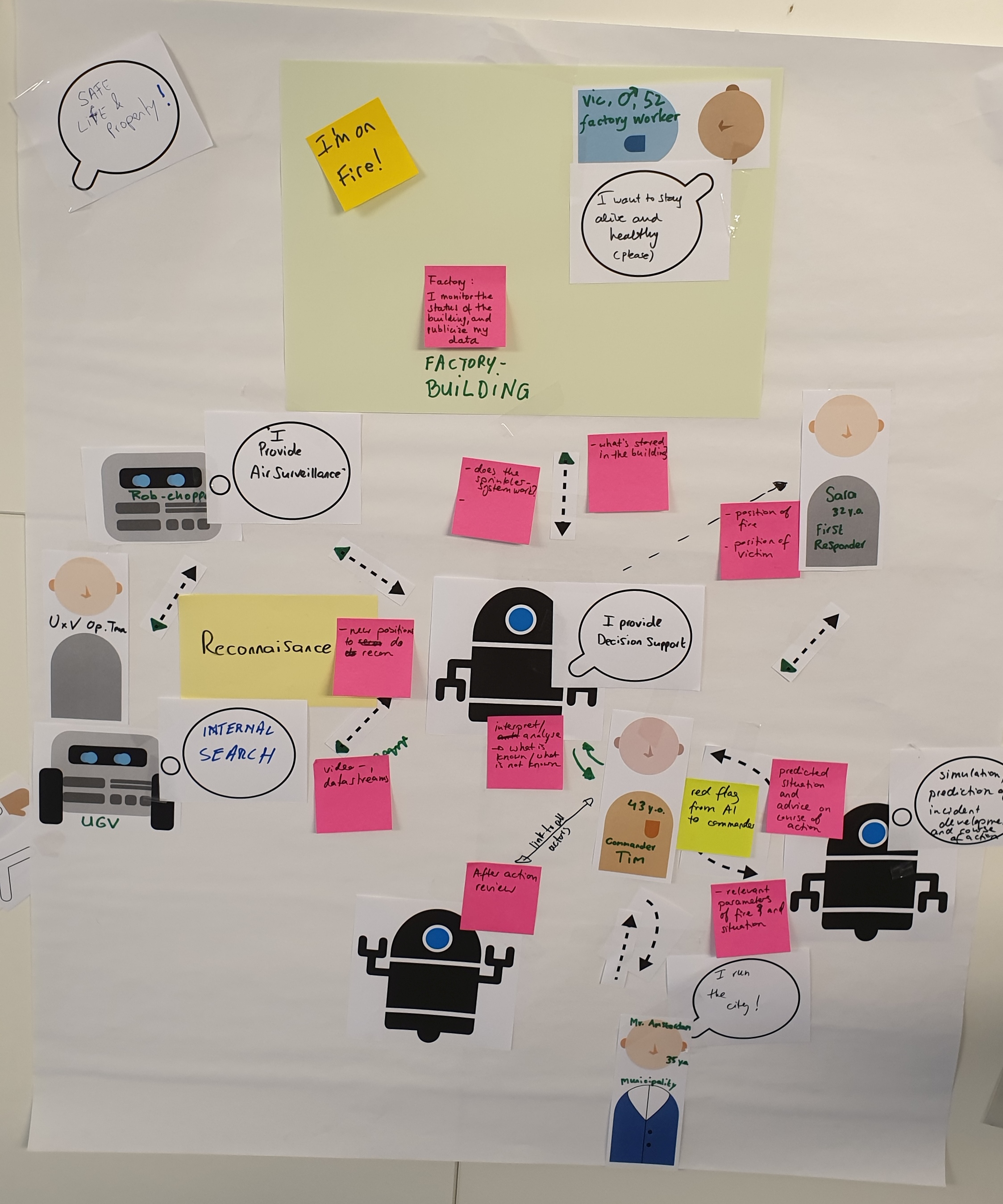
In particular, the challenges associated with the development and deployment of AI-based support systems call for a shift toward a human-centered design approach to design applications in which humans and AI co-evolve over time through mutual adaptation and continuous improvement. This approach can be addressed by HI. Specifically, human capabilities are augmented by their complementary AI capabilities, thus achieving improved results overall. To achieve a better understanding of how HI systems can support health care and well-being and to explore the key challenges for HI systems for health care, this workshop will focus on addressing why we need HI and how HI differs from just AI-based systems for health care. During the interactive session, we will map out design patterns for different healthcare applications following human-centered design principles (see figure below for an example).
Developing HI systems for health and well-being is an interdisciplinary research effort by nature. This requires people from various related fields such as computer science, human-computer interaction, psychology, medicine, etc., to exchange their perspectives and collaborate. Therefore, in this workshop, we also want to focus on community building, interdisciplinary exchange, and discussion among participants.
Keynote by Judith Masthoff
 Judith Masthoff is a full professor in the Human-Centered Computing group at Utrecht University. She researches intelligent user interfaces, specializing in personalization, persuasive technology, and adaptive systems for domains including e‑health, sustainable transport, and education. Her work on group adaptation and personalized e‑learning covers topics such as adaptive tutoring, feedback, exercise selection, and emotional support. Her projects cover topics such as diabetes walking coaches, study motivation, sustainable mobility, elder social interaction, and cancer self‑monitoring. She is part of the AI4Health consortium, which recently received long-term funding for research on making AI useful for care professionals and patients.
Abstract of the keynote: As AI becomes increasingly integrated into healthcare, the challenge is not only to develop intelligent systems, but to ensure they fit the needs and practices of the people who use them, while adapting to their preferences, circumstances, and goals. Achieving this requires a thorough understanding of the diverse stakeholders involved, their needs, goals, and preferences, and the contexts in which these systems are used. Drawing on examples from healthcare and other domains, this keynote will illustrate how insights into users and context can inform the design of hybrid intelligence systems, including the personalization of AI support to individual users and situations. It will also discuss how factors such as trust, transparency, control, and human biases influence the acceptance, use, and effectiveness of human-AI collaboration. Finally, it will briefly reflect on some of the key human-centred AI challenges that will be addressed in the forthcoming AI4Health programme.
Accepted Papers
- Christian Fleiner and Robbe Claeys. The Ishikawa Diagram as an Enabler for Hybrid Intelligence in Healthcare
- Abdallah Al-Janabi and Michel Klein. Hybrid Causal Discovery Using Human- and LLM-Based Domain Expertise
- Floris den Hengst, Shihan Wang, Piek Vossen, Quirine Smit, Maaike H. T. de Boer, Bram Willemsen and Ilke Asal. Towards a Hybrid Diabetes Lifestyle Support Agent with a Long-Term Memory
- Tommaso Zendron, Josephine Mélot Chesnel, Berke Yazan and Emma M. van Zoelen. AI as a Mediator of Information: a Consent-Aware Team Design Pattern for Appropriate Trust in Healthcare
Authors of these papers will present their work in the lightning talks in de morning session. These papers will be used in the session after to create design patterns.
Submissions
We invite people to submit a two-page, single space, single column extended abstract that describes your application or envisioned system on HI in health care. We do not require the submissions to be current work in progress: the goal of the submission is for us to have potential HI systems in health care to create the design patterns with. The papers can be added to the postproceedings (optional). Please follow the Frontiers of AI series by IOS Press format. The submission format is single-blind. The link to the EasyChair submission page is here: HI4healthcare.
Important Dates
- EXTENDED: May 22, 2026: Workshop deadline for contributions
- June 5, 2026: Paper acceptance notification
- July 7, 2026: Workshop
Organizing Team
Maaike de Boer
 Maaike de Boer (PhD) is a senior Scientist at TNO within the Data Science department. At TNO Maaike focuses on Hybrid AI – specifically combining language models and knowledge graphs / ontologies. She is part of the transfer lab between TNO and the Dutch Hybrid Intelligence program, and (co-)leads the case study on the Health Care domain.
Emma van Zoelen
 Emma van Zoelen is a scientist at the TNO Human-Machine Teaming department. She recently finished her PhD on human-machine co-learning, in which she studied collaboration patterns that emerge as a result of human and machine adaptivity. At TNO, she researches human-machine interactions and collaborations as well as topics related to responsible AI. She is part of the transfer lab between TNO and the Dutch Hybrid Intelligence program, and (co-)leads the case study on the Health Care domain.
Mark Neerincx
 Mark Neerincx is full professor in Human-Centered Computing at the Delft University of Technology, and principal scientist at TNO Human-Machine Teaming. His research focuses on the socio-cognitive engineering of human–agent/robot collaboration across domains such as healthcare, security, and defense, with the aim of enhancing social, cognitive, affective, and physical processes and enabling meaningful human–agent partnerships. This work emphasizes sustained, memory-based agent support for meaningful activities and moral decision-making, fostering reflective processes, value awareness, and adaptive human–agent collaboration over time.
Annette ten Teije
 Annette ten Teije is full professor of Artificial Intelligence in Medicine at the Vrije Universiteit Amsterdam (Learning&Reasoning group), and she specializes in decision systems within the medical field. Her research encompasses various medical domains, including medical guidelines, quality indicators, and clinical studies. Ten Teije’s primary focus lies in the application of knowledge-driven methods and their integration with data-driven approaches. She is particularly interested in formalizing architecture patterns for systems that combine learning and reasoning, as well as developing a theory to determine the appropriate use of these patterns.
Program Committee
- Thomas Schmid, Medizinische Fakultät, Martin Luther University Halle-Wittenberg, Germany
- Tina Mioch, Hogeschool Utrecht and TU Delft, the Netherlands
- Stefani Tsaneva, WU Vienna, Austria
- Christian Fleiner, KU Leuven, Belgium
For more information: please email us using hi4healthcare@gmail.com.